Indoor Drone Inspection in GPS-Denied Spaces
How flight modes, sensors, and cage or lidar setups let aerial robots inspect warehouses and tanks where GPS is unavailable.
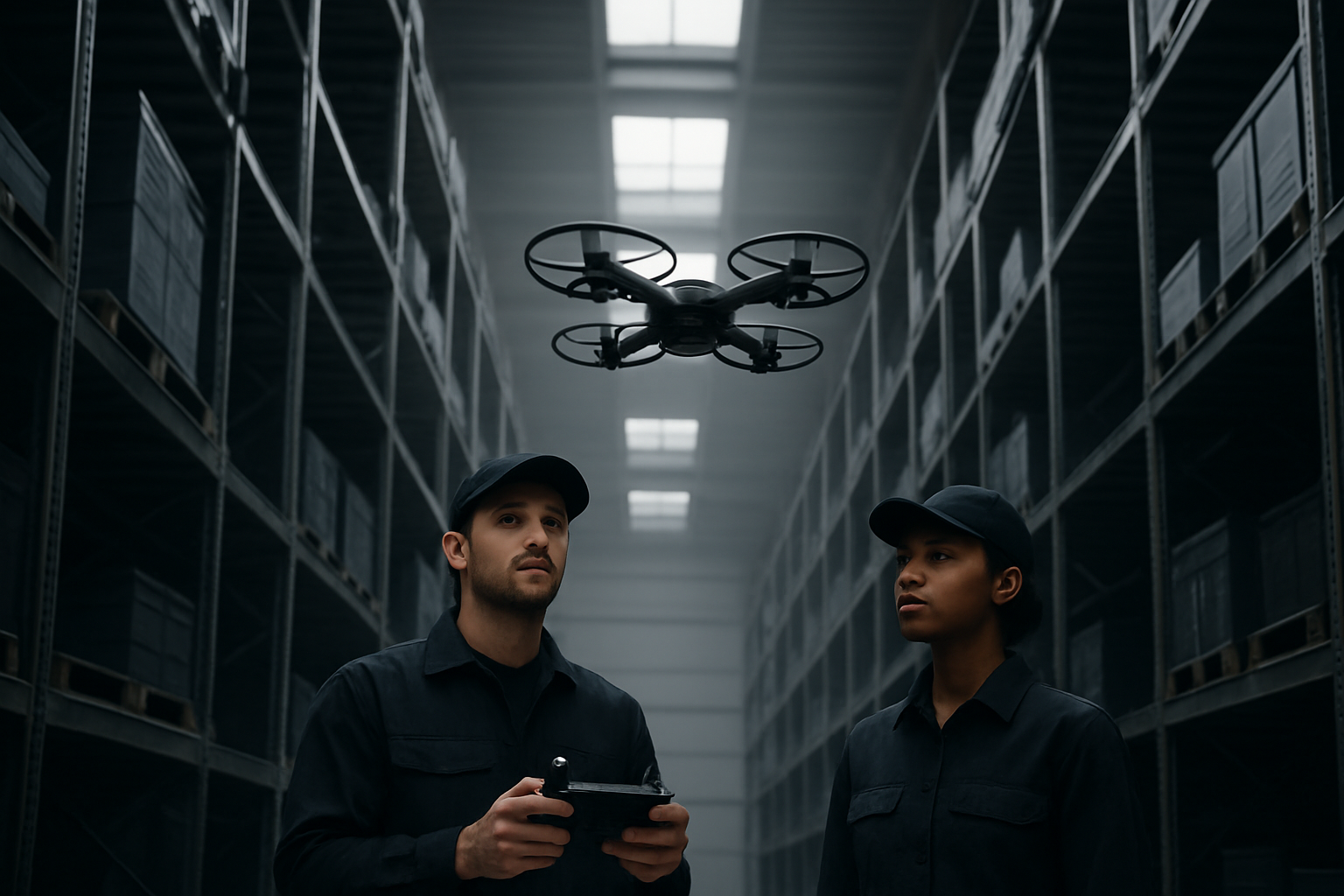
Indoor drone inspection means flying an aerial robot inside a structure — a warehouse, a storage tank, a turbine hall, a silo — where the satellite positioning that normally keeps a drone steady is unavailable. That one constraint reshapes everything that follows: which flight mode the aircraft holds, which sensors it trusts for position, whether the airframe needs a cage, and how the crew keeps it clear of steel, cable trays, and people.
The assets that are expensive to scaffold, rope-access, or shut down are often the ones with ceilings, roof trusses, and interior surfaces that are awkward to see from the floor. An aerial robot can hold a camera or a thermal sensor close to a seam or a racking beam without putting a person at height.
What does not transfer indoors is the assumption of positional certainty. What follows is how teams close that gap.
Why GPS fails indoors
GNSS depends on weak radio signals arriving from orbit. A concrete roof, a steel deck, or a few floors of racking attenuate them below what a receiver can use, and inside a metal tank the receiver sees almost nothing. Reflections off steel add multipath errors, so the aircraft believes it is somewhere it is not. Most flight controllers degrade rather than fail, leaving position hold for a mode built on other references. The useful question is which reference, and how the handover behaves.
The position sources that work indoors
- Visual-inertial odometry. A camera tracks features while an inertial unit measures motion; solid over textured surfaces, weak over glossy, wet, or uniform floors.
- Optical flow with a rangefinder. Stable low-altitude hover, given surface texture and a reliable height reading.
- LiDAR or laser SLAM. Maps the space and localises against it, tolerates low light, and returns a point cloud as a secondary deliverable. Reflective metal and thin structures stay difficult.
- Fixed references. Anchors or surveyed markers give repeatable positioning in a known space, at the cost of setup time.
Position is always an estimate. Ask how it degrades.
Flight modes and what they ask of the pilot
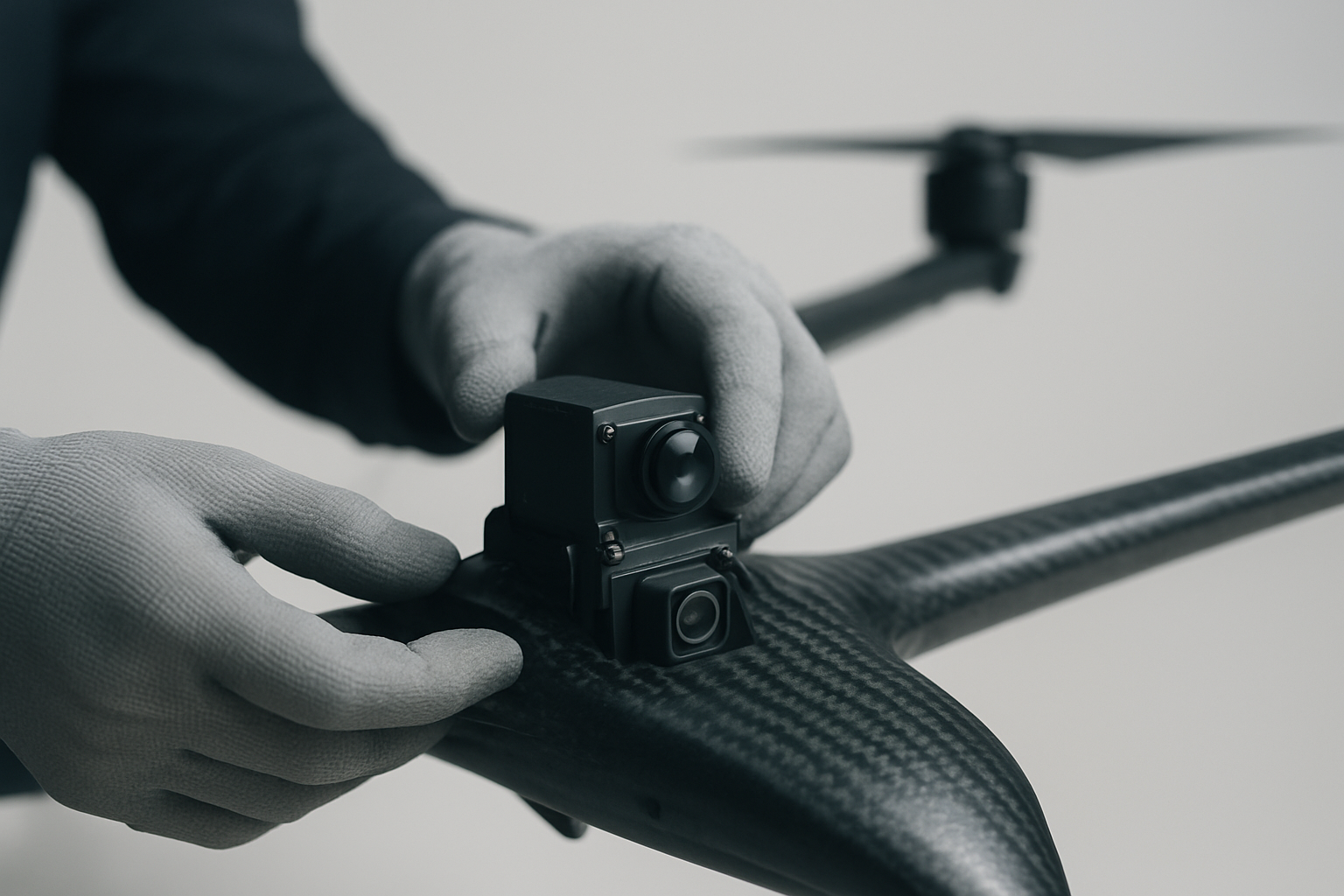
Attitude mode
Holds attitude, not position. It is the common fallback inside enclosures and puts the aircraft entirely in the pilot's hands: ground effect, draughts, and the aircraft's own turbulence all move it.
Position hold on visual references
More forgiving, and a sensible default for warehouse work. It still depends on the floor beneath — over shrink-wrapped pallets or a puddle, the reference can vanish.
Map-based navigation
SLAM or a pre-scanned point cloud allows repeatable waypoints and consistent photo stations between inspections, which is what turns a flight into comparable data.
Waypoint modes
Waypoints are only as good as the position source feeding them, and altitude above the takeoff point is not altitude above the asset.
Sensors and payloads for tight, low-light spaces
Visual cameras
A stabilised gimbal with high-resolution stills remains the workhorse. Indoor lighting is uneven and often flickers, so test flicker handling and high-contrast scenes before relying on it for defect records.
Thermal
Radiometric thermal records temperature values, not just an image, which suits moisture, insulation gaps, and electrical hotspots. Bare metal has low emissivity and reads misleadingly; note the surface before drawing conclusions.
Obstacle sensing
Omnidirectional sensors are an assistance layer, not a safeguard. Thin items — cables, scaffold tubes, wire rope — are the classic blind spot. Fly as though they are not detected.
Environmental sensors
Gas and particulate sensors can sample where a person cannot comfortably stand. A reading is a data point for a competent person, not clearance to enter.
Cages, tethers, and airframe choices
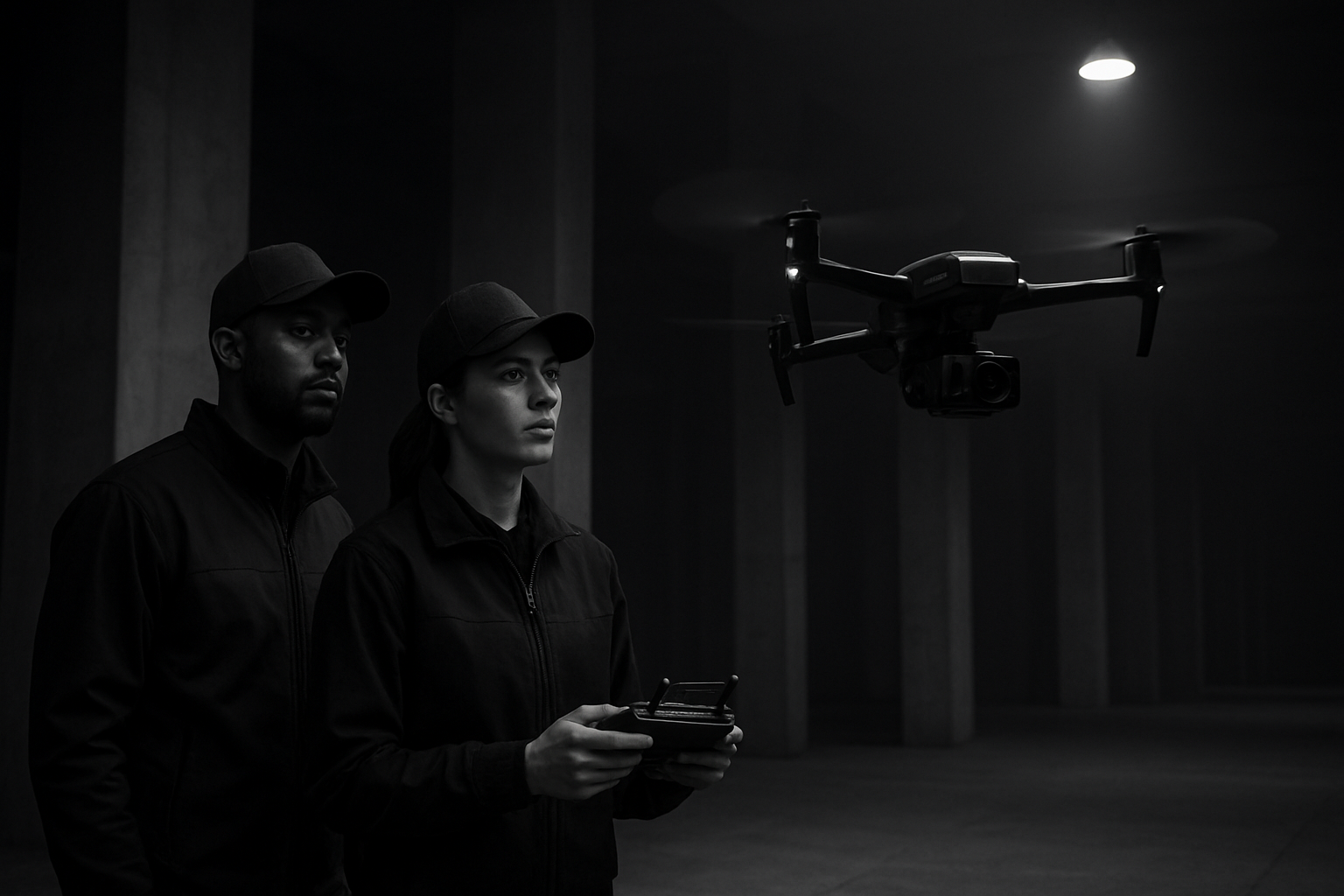
Prop guards and full cages
A cage protects the aircraft and the asset, and earns its weight in tanks, ducts, and anywhere the aircraft works close to a delicate surface or a person. The trade is drag, weight, and flight time.
Tethered operation
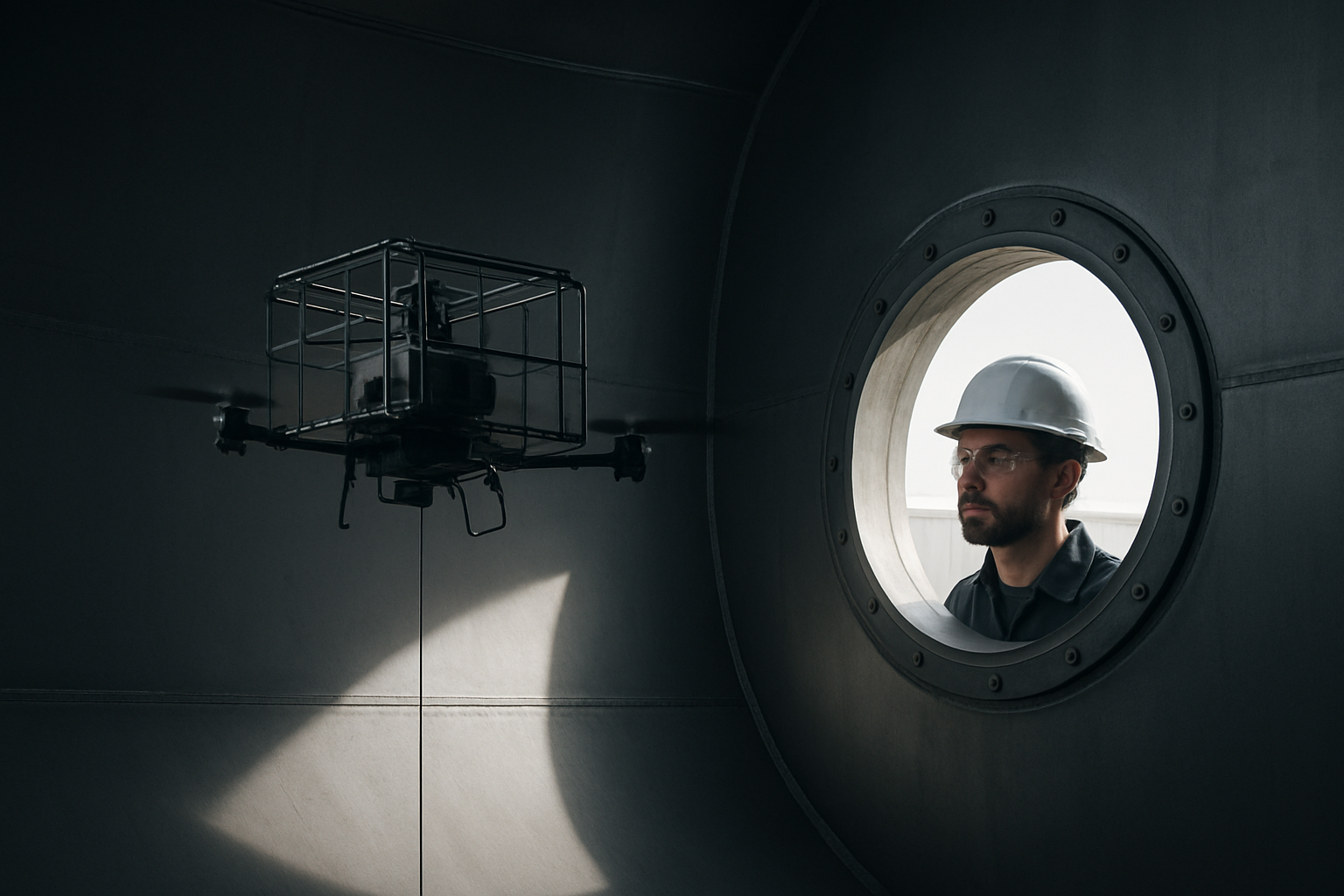
A tether supplies power, sometimes data, and removes battery anxiety from a long tank inspection. The cost is a line to manage and a flight path without tight turns.
Downwash and dust
Propellers move a surprising volume of air. In a confined space that lifts settled dust onto surfaces and lenses. Plan ventilation, settle time, and a lens routine.
Before the first indoor flight
- Rules. An indoor flight may sit outside civil aviation rules and still be inside employer safety rules, confined-space entry rules, and insurance conditions. Confirm all three in writing.
- Atmosphere. A potentially flammable atmosphere plus an uncertified aircraft is a combination to avoid. Ask about certification for the specific zone instead of assuming.
- People. Exclusion zone, a spotter with a clear view, agreed abort signals.
- Data. Decide resolution, coverage, storage, and who reviews the imagery before the flight.
FAQ
Can an aerial robot fly indoors without GPS?
Yes. Platforms position themselves from visual-inertial odometry, optical flow, LiDAR SLAM, or fixed anchors, depending on the design. A remote pilot stays responsible, and the position estimate should be treated as one.
Do I need a cage for tank inspection?
Not always. A cage helps when the aircraft works close to steel and a contact event would be costly, but it costs flight time. A guarded airframe on a tether is often the more conservative starting point.
What should I ask before an indoor demo?
Which position source the aircraft uses and what happens when it degrades, where obstacle sensing is blind, how much downwash the airframe produces, whether the thermal payload is radiometric, and how imagery and point clouds are exported.
Indoor inspection rewards preparation more than piloting flair. Flypio develops aerial, legged, and terrestrial robotic platforms for teams evaluating robotic support in complex environments, including the Kestrel aerial robot. Request a demo to discuss how Flypio robotics may fit your operational needs at flypio.com.