Legged Robot vs Wheeled Robot: Choosing for Your Plant
Choosing between legged and wheeled robots in a plant: surfaces, stairs, inspection routes, and when a mixed fleet is the honest answer.
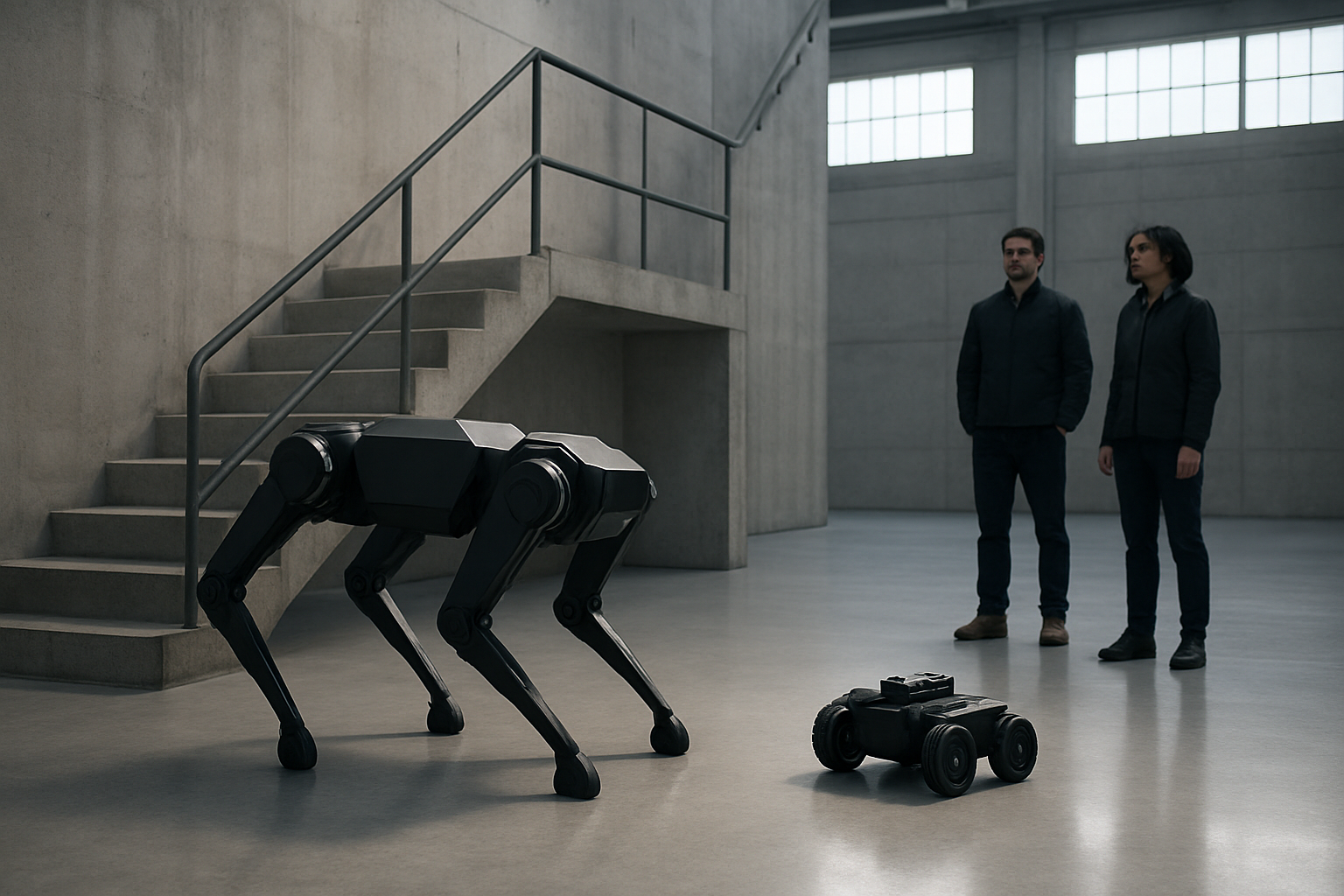
The legged robot vs wheeled robot question rarely gets settled in a meeting room. It gets settled on the plant floor: at a stairwell landing, at a door threshold, on a loading apron where the concrete has settled after years of traffic. Teams that test both platforms against the routes their people already walk reach a defensible decision quickly. Teams that compare specifications in isolation often end up with a machine that handles the demo aisle and struggles everywhere else.
This article covers which surfaces and transitions favor wheeled platforms, which inspection routes favor legged ones, and where the honest answer is a mixed fleet — a wheeled unit for the long flat runs, a legged unit for the places that were built for people, not for wheels.
A note on scope: this is a selection framework, not a specification sheet. Flypio develops aerial, legged, and terrestrial robotics platforms, and any capability described here should be validated on your site during an evaluation rather than assumed from a category label.
Where wheeled platforms make sense
Smooth floors and long corridors
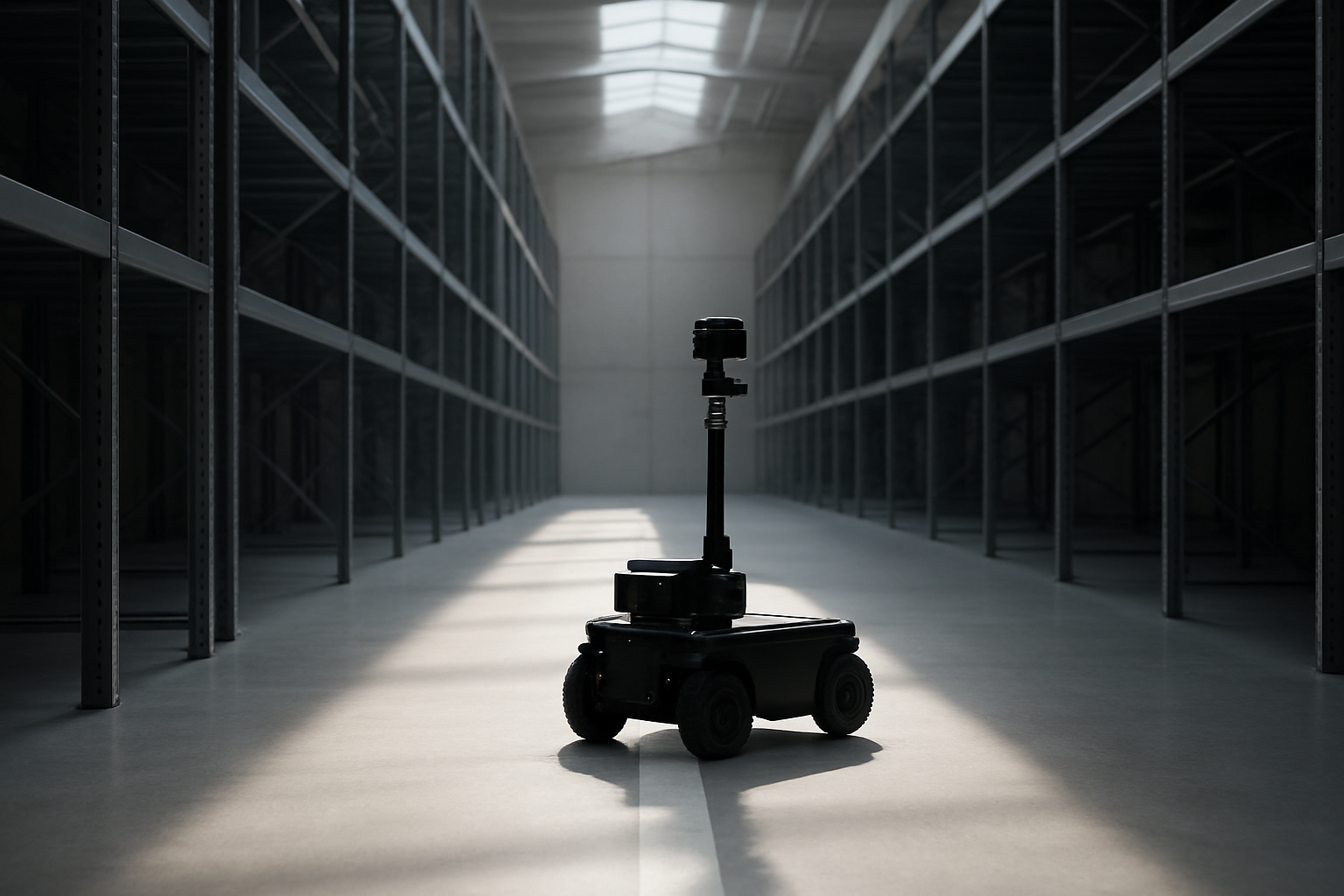
Wheeled robots are at their best on the surfaces most industrial facilities already have: sealed concrete, epoxy, tile, asphalt, and the painted walkways between production lines. There, a wheeled platform can move a payload with a simple drivetrain, a low center of gravity, and a fraction of the mechanical complexity of a walking system. Fewer actuators means fewer components to inspect, lubricate, and replace.
Payload, endurance, and simple maintenance
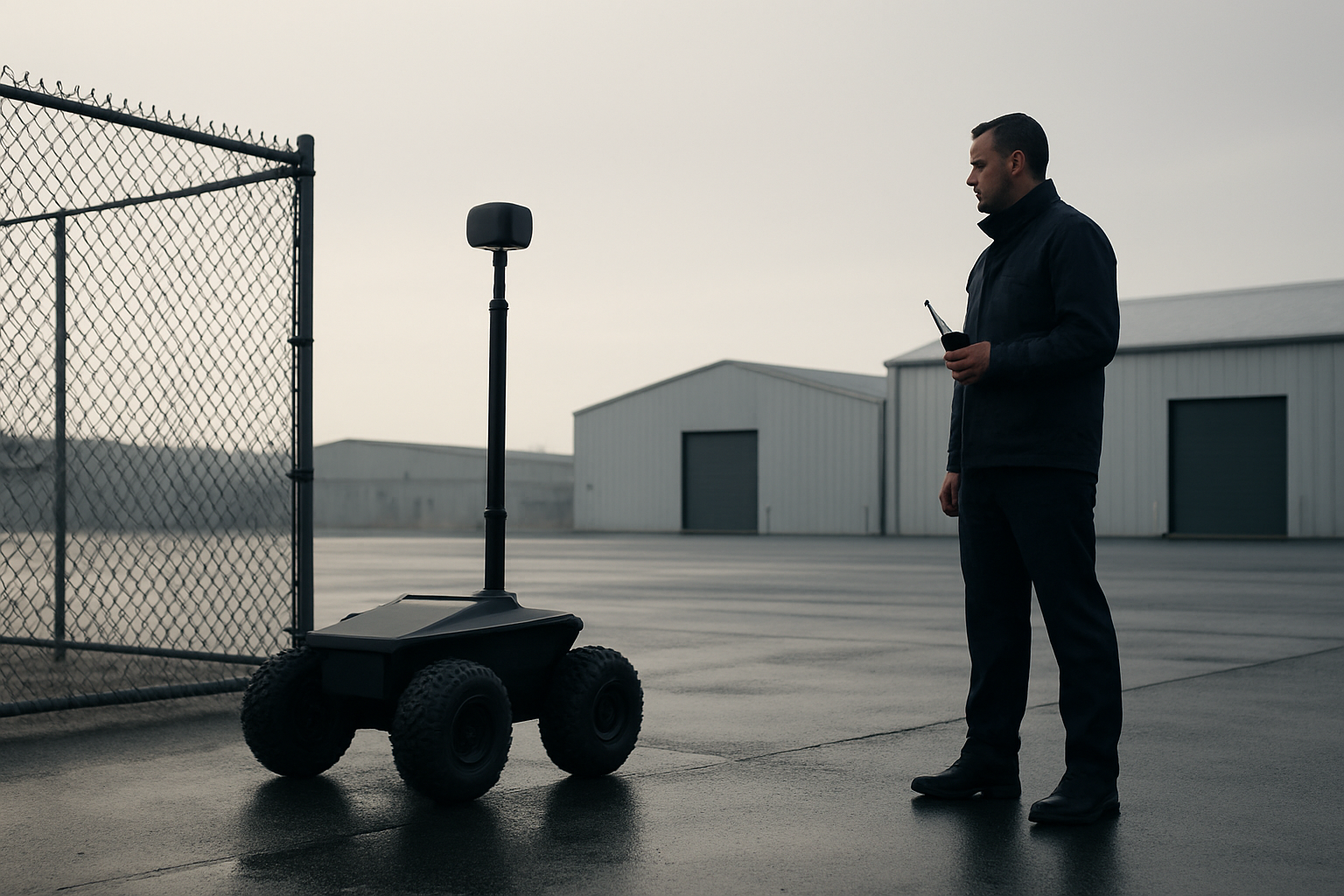
If the mission is repetitive coverage of a large flat area — a paved perimeter fence line, a warehouse aisle loop, a parking deck — wheels usually offer more payload margin and simpler power budgeting per meter traveled, with a short spare-parts list.
The limitation is equally clear. A wheeled platform is designed around one assumption: that the surface continues. Break that assumption — a curb, a cable ramp, a grated stair, a raised mezzanine lip — and the vehicle needs a ramp built for it, a lift, or a different machine.
Where legged robots change the map
Stairs, thresholds, and mixed surfaces
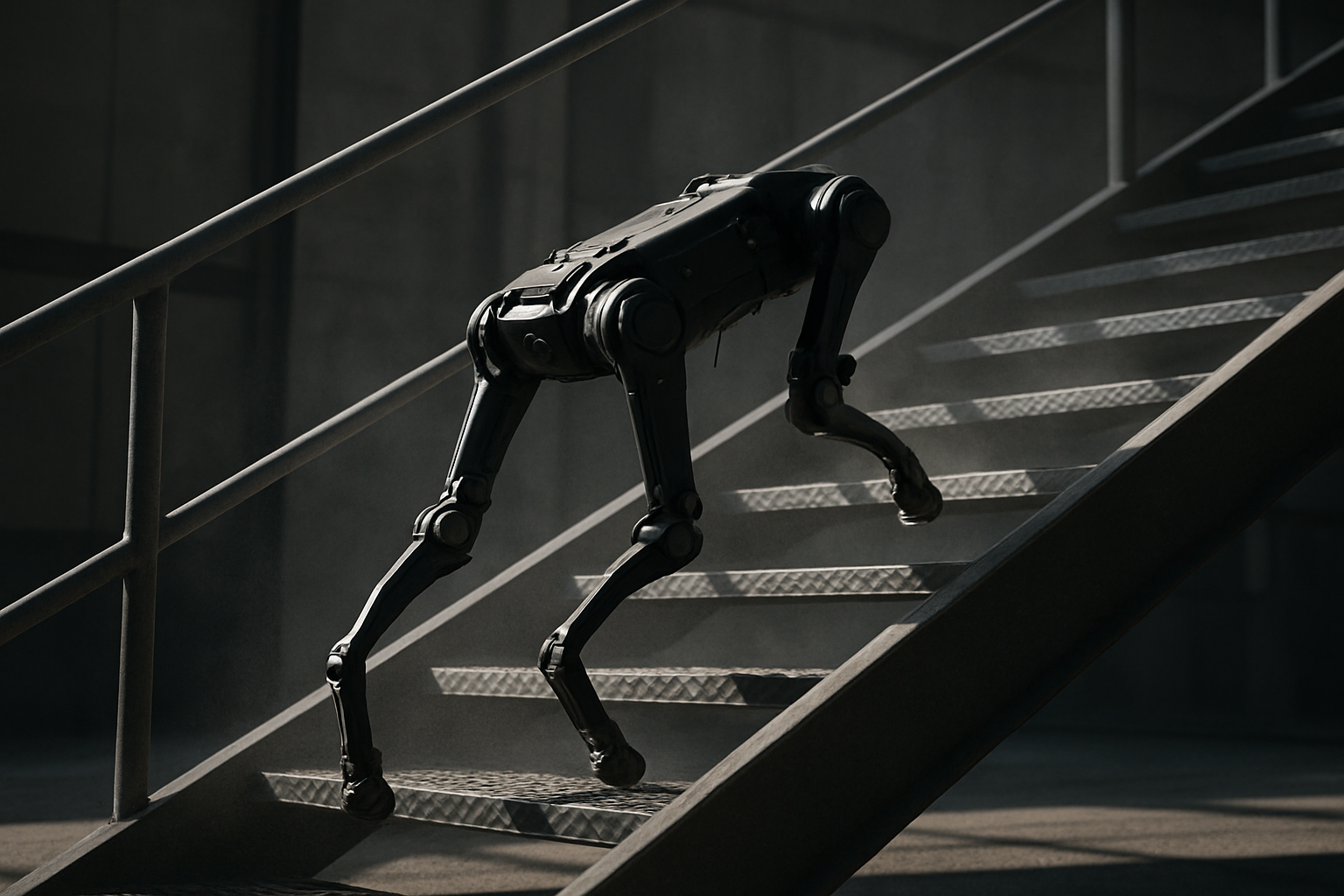
A legged robot, such as Flypio's Saltica platform, is designed for scenarios where mobility and terrain adaptability matter. That phrasing is deliberate. Legs do not make a robot better everywhere; they make it possible to keep moving when the surface stops being a surface — stairs between mezzanine levels, uneven ground between buildings, transitions between gravel and concrete, narrow landings, and the awkward geometry that exists in real plants but not in floor plans.
Inspection routes that were built for people
Most inspection routes in industrial facilities were designed for a person with a flashlight. They go up a staircase, past a valve cluster, and along a catwalk. A wheeled platform can cover the flat portion. A legged platform may follow more of the route without a human handoff at each transition. If the inspection value sits at the top of the stairs and behind thresholds, that is the signal to look closely at legs.
Legs also change the failure profile. A wheeled robot that meets an obstacle stops. A legged robot has more options — step over, step around, climb — and more complexity to manage when an option fails. Ask to see that recovery behavior on your own site, not in a video.
What to evaluate before you commit
Audit the surface, not the spec sheet
Walk the proposed route with a tape measure and a phone camera. Record surfaces, transitions, gradients, door widths, stair geometry, and lighting, then count transitions per loop. A route with two transitions is a wheeled route with exceptions. A route with thirty is a legged route.
Match the duty cycle to the platform
Ask how long the route is, how often it repeats, and what the robot must carry. Wheeled platforms generally handle long, flat, repetitive loops with less mechanical overhead. Legged platforms generally handle shorter, obstacle-dense routes where the value is reaching places rather than covering distance.
Define what supervised means
For most industrial evaluations the realistic operating mode is supervised, not unattended. Define where the operator stands, how they intervene, what the escalation path is, and how the robot reports position and status. That answer shapes the platform choice as much as the terrain does.
Plan the data path
Cameras and sensor payloads need bandwidth, storage, and a destination. Decide before the trial where inspection data lands and who reviews it.
When a mixed fleet is the honest answer
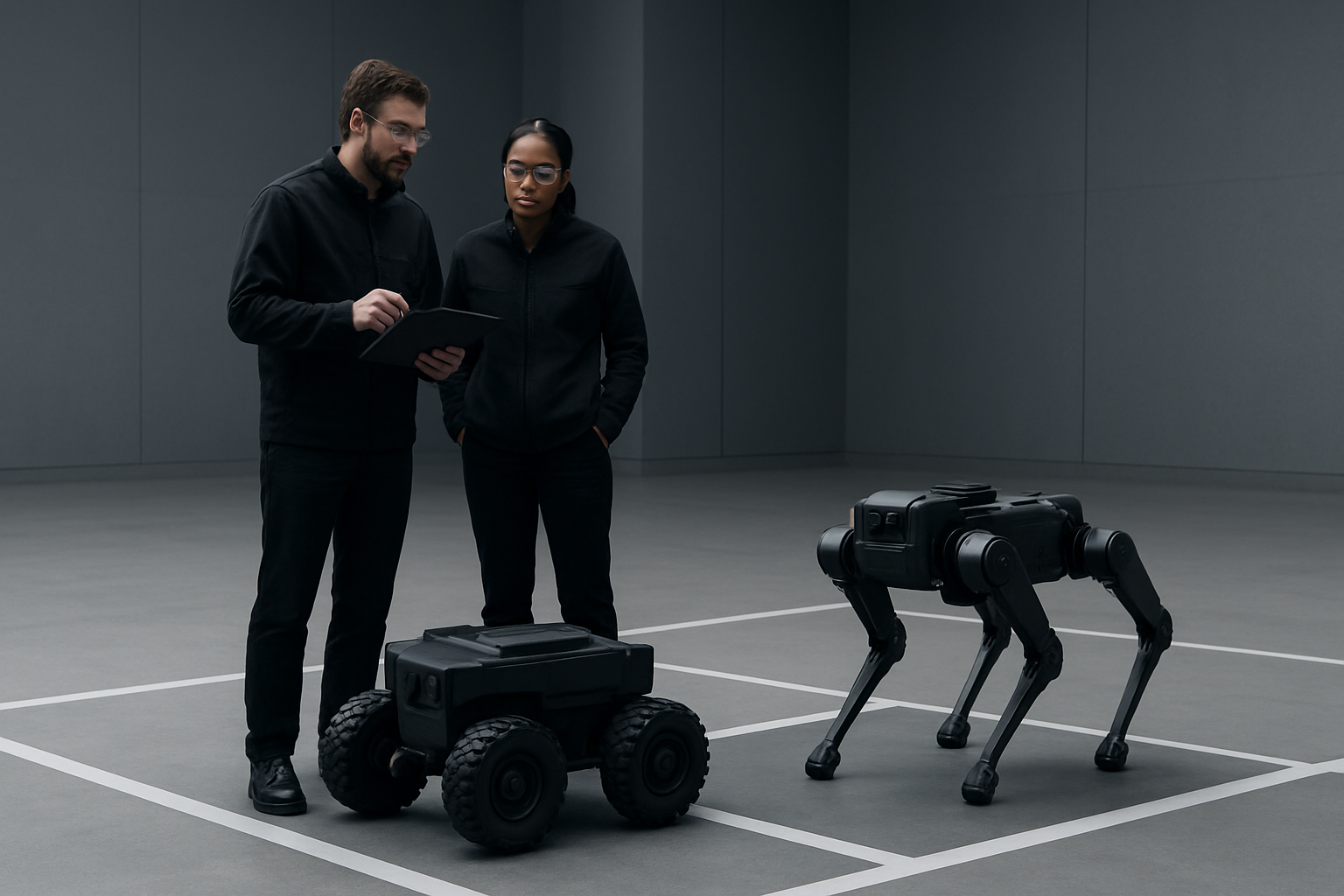
Some sites should not pick one. A plant with a long paved perimeter and a multi-level process area often gets better coverage from a wheeled platform outside and a legged platform inside — or from an aerial robot such as Kestrel where the question is line of sight over terrain rather than contact with it.
A mixed fleet costs more to manage: more training, more spares, more integration surface. It is worth it when the alternative is building ramps and lifts to force one platform to fit, or accepting that half the inspection route stays manual.
FAQ
Is a legged robot always better on stairs?
No. Legs expand the set of stairs a platform may handle, but tread depth, handrails, landing space, and approach angle all affect whether a specific robot can use a specific stairwell. Test the actual stair.
Can a wheeled robot handle outdoor terrain?
Some can, on prepared surfaces such as asphalt, packed gravel, and concrete aprons. Loose soil, mud, curbs, and rubble are where wheeled mobility usually loses efficiency, and where terrain adaptability becomes the deciding factor.
How should we run the comparison?
Pick one representative route per candidate platform, walk it with the vendor, and define success in operational terms: route completion, intervention count, data quality, and operator time. Compare platforms on the same route, not on the same brochure.
Explore Flypio's robotics platforms and request a demo to discuss how aerial, legged, and terrestrial systems may fit your operational needs.